How might a city host an annual hunt that tells a different civic story each year? In this post, graduate designer Michael Barletta reveals how the District Hunt unfolded in 2025 — and how it contrasts to commercial products like those from Escapely.
—-
One of the most amazing neighborhood games in DC takes place every year as a two-day hunt in October, with a story tied to local history. Last year, we sent a team – and below is their story.
It is a model for involving neighborhood groups, collaborative design, and balancing storytelling with puzzles. The designers are a company called Game Genius, and the game is called the District Hunt. In 2025, the theme was disinformation.
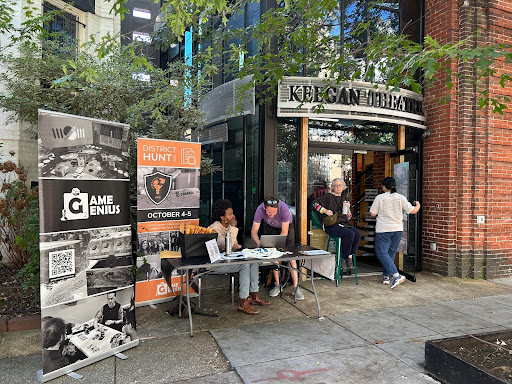
Our five-person team of included several graduate students in the Game Center at American University…

It was a five hour experience, at least for us. Some people played for just an hour – and that was totally ok with the designers; in fact, they packed more of the narrative in the earlier portions to make the experience fun for those who just had an hour or two. Others approached it like a race – and there were prizes for whoever finished first.

Each year the hunt is focused on a different civic theme – including women’s history, mental health, food/housing, and literacy. The clues last year included DC-raised musicians, such as guitarist Chuck Brown.
The theme of ‘disinformation’ was timely for DC neighborhoods – and made for some great puzzles! There were 19 puzzles across 6 locations. Neighborhoods like Dupont Circle are home to congress and longtime residents with no political ambitions alike. The fountain in the photograph at right appeared in the game, both as a postcard puzzle and as something you could physically walk by.

Their narrative was historical fiction: real facts from history, paired with a supporting cast of fictional archivists called “couriers.” This allowed the game to be very faithful to the truth, while also creating a wonderful story about a secret society working to preserve history. Players were tasked with helping a courier who had gone missing, and recovering some of their collection.
The story helped keep us invested in the hunt as we explored the surrounding area for more clues. The District Hunt took us all around the surrounding area, going from place to place looking for more clues relating to the couriers and DC history!
Most elements were analog, including paper envelopes. One of our favorite mechanics was an unmarked mail slot for submitting answers to the first level. If you guessed wrong, the physical envelope came back out 30 seconds later with circles in pen around what you needed to fix. Correct answers led to a new packet emerging from the mail slot, including a set of photographs that turned out to be a puzzle to solve.

As part of play, teams nominated moments from recent DC history that deserve more attention. This brainstorm process was a different kind of puzzle that required the team to agree on the significance of a current event and object. After the game, these ideas were published as part of an “impact report” by the game hosts. Nominations included:
- A brick from the Black Lives Matter Plaza
- A copy of the final Washington City Paper
- A knife-torn vest from January 6th
- A microphone once used by Willis Conover at Voice of America
- “Don’t Mute DC” storefront speakers
- A bat from the Nationals’ World Series win
The day began at a neighborhood theater (the Keegan), which was entirely taken over — including with live actors behind the concessions counter who responded to key phrases, musical clues playing on the second floor, and a darkened stage with an old-fashioned radio playing another clue. The hunt then continued into the surrounding area having puzzlers visit famous locations in DC like Dupont Circle. The hunt featured a mix of analog and digital elements including:
- A live text support line
- Certain parts of puzzles were to be submitted through online forms
- QR codes and a PDF of puzzle solving tools
- The use of maps on phones and digital communication
- A clue in the form of an email sent out the day before the hunt started
- The use of google drives and google folders.
The operators didn’t try to limit outside technology. At the same time, “cheating” with technology didn’t get you far. This shaped the kind of puzzles that could be offered to players.
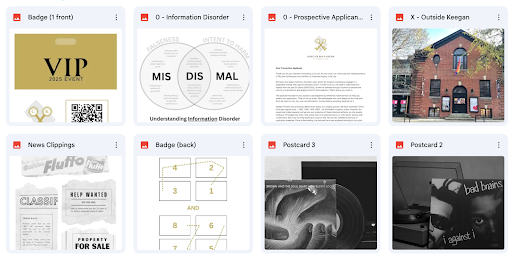
There were three chapters or “levels” for the game. Each took about one-third of the team’s time. The first level was centered around a specific location (i.e., the aforementioned Keegan Theater). Puzzlers were given a manila envelope filled with various physical materials to use during the hunt. Postcards, fake letters, and even posters put up in real spaces that looked very real were part of the experience. Across the 19 puzzles, the variety was enormous. Some were physical, like the folding map that revealed the direction you should go to. Once puzzlers were able to properly fill out the answer for the first level, they were given materials for the second level, which would have players go to multiple locations to gather clues leading puzzlers to a Teahouse called Teaism, where using a secret code would give them the clue to the final level of the puzzle hunt. After gaining access to a shared google drive, players navigated through a series of puzzles in the final level to discover that the artifact was located in Labyrinth Puzzles and Games.

To achieve a district wide puzzle hunt, the designers took many different viewpoints into account. They wanted to ensure that the hunt not only had strong puzzles and clues, but a strong narrative and connection to the community. Based on our conversations with the designers, the experience of making the hunt was akin to that of a TV writers room. A team of roughly 10 designers work together to make a cohesive puzzle, and had a lot of fun building on each others’ ideas. What makes this work is the different viewpoints the team brings to the table. There is a focus on multiple different aspects of the hunt, including marketing, narrative and the puzzles themselves. All of these components manifest in utilizing local spaces as well as a network of volunteers with a multitude of different roles to ensure that the games ran smoothly. Some volunteers were tasked with riding around the neighborhood, checking to make sure that clues placed out in the open were still where they were supposed to be. Volunteers also enforced more concrete rules, such as manning the door of the Keegan theater. This was to ensure that players did not use phones while inside the theater, which could be used to garner information or take photos. Their aim was to keep the game story heavy in the beginning, allowing players to immediately immerse themselves and think in the context of the story. The team works hard to make sure they can weave their narrative throughout the hunt, keeping it engaging for players.
Puzzle hunts are especially interesting when compared to their more commercial counterparts. The boundaries of puzzle hunts continue to be pushed with commercial hunts like Escapely. Escapely sells boxes online to receive clues and a lock box pertaining to a city or neighborhood. Each box comes with its own unique story. This is similar to the District Hunt in that both offered a unique story to keep the hunt engaging and related to the area, and yet differ in many other ways. Escapley encourages using your own time to solve the puzzles, giving puzzlers the ability to take as long or as little as they would like on puzzles, with no consequence of the hunt ending. By contrast, in the District Hunt puzzlers only had one weekend to solve the puzzle.
Due to Escapely being a contained packaged game unlike the District Hunt, there is also no support system like a texting hotline. Instead, they package hints for the players to open at their own discretion, letting them moderate themselves and set their own difficulty. Since escapely is also more commercial than the District Hunt, there is a standard price point for each box as opposed to the ticket based system for something like the District Hunt. There is also more variability in difficulty for something like Escapely. Whereas the District Hunt is designed with certain difficulty levels in mind, Escapely challenges the puzzlers to establish their own difficulty, using as many or as few hints as they please.
Another key difference between Escapely and something like the District Hunt is the civic connection a local puzzle hunt can offer. A local hunt can incorporate and utilize institutions in the community as well as teams of volunteers to ensure things go smoothly, whereas with a commercial hunt like Escapely, the onus is completely on the players to seek deeper connections to the community and its institutions.
