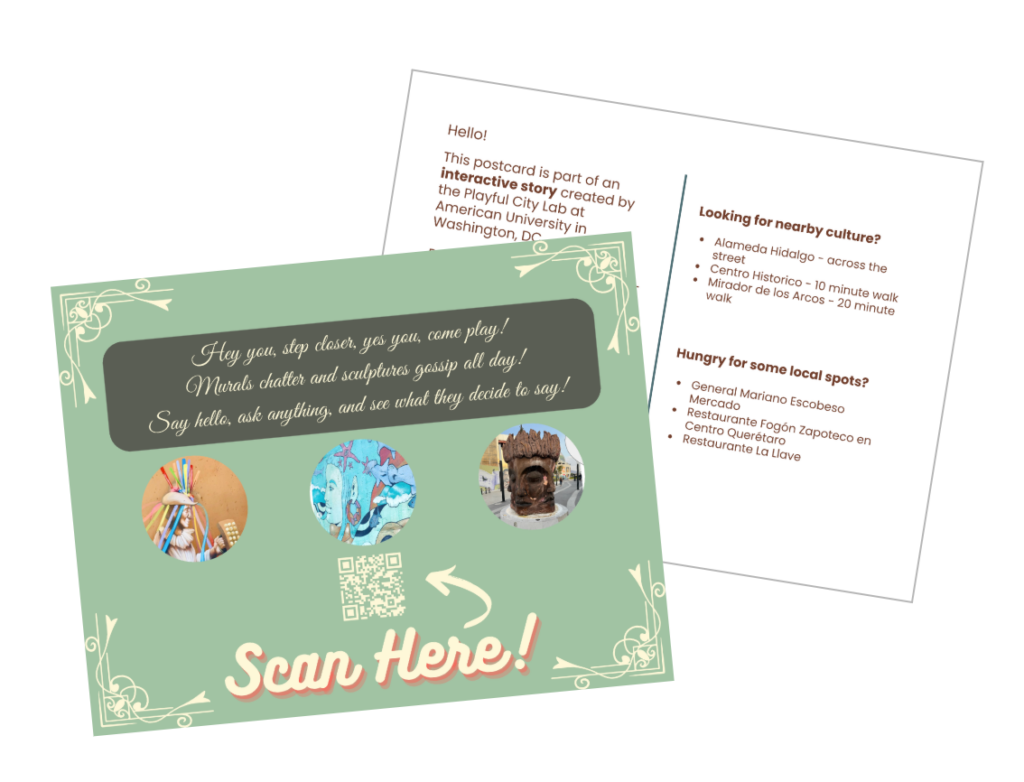
What if an activity’s impact can be doubled through print materials that offer peripheral vision of the surrounding neighborhood, including things to do afterward? In the case study below, we will show how postcards can start the story game and pull the player into neighborhood assets.
We call them “portal” postcards because they are portals into the extended reality experience, like the start of a story game. They might include a first QR code, a secret phone number, or an opening line of dialog. But it isn’t easy to include peripheral vision as the same time…
The real trick is to maintain two realities. Specifically, we argue for (1) embracing one narrative style for “in story” communication tied to the story game narrative, and (2) contrasting it visually with the “out of story” peripheral vision — including seeds for secondary adventures after the game is over, nearby food ideas with resident insights, and broader storytelling of the neighborhood.
Case Study of a “Postcard in Two Registers”
Below, we create a postcard as part of our work in the Mexican town of Queretaro (see also our clever tech). Our explicit goal is to create a kind of peripheral vision – drawing attention to additional cultural assets and signals that the experience extends beyond the core mechanics.
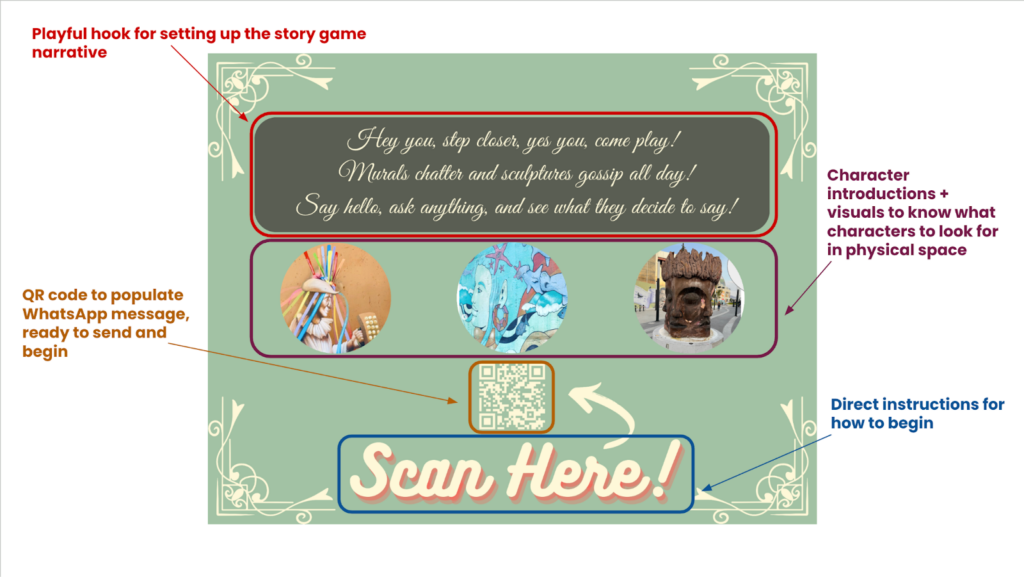
The front of the postcard exists fully within the world of the game; the language, tone, design, and visuals all exist within the context of the game world. “In-world” communication can offer guidance, clues, or other information that helps players understand the game, how to engage with it, or any rules that they may need to know to play. Since this communication is separate from “out-of-world” communication, the tone and voice of “in-world” materials can remain consistent, reducing any potential friction for players discovering how to play, especially for the first time.
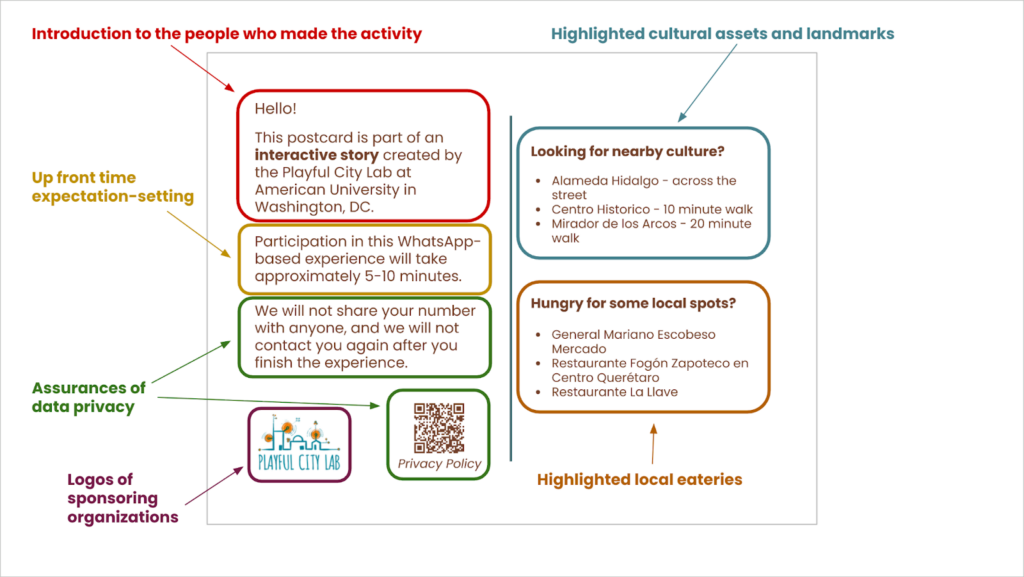
When the postcard is flipped, the player is actively leaving the game world and returning to reality for information that is more practical or important to them as people, not players. We chose to communicate who made the game, how long they can expect to commit to (should they choose to play), answer any questions about data privacy, and redirect engaged players to cultural assets/landmarks and local small businesses. We suspect the physical action of flipping the card is helpful for providing that clear line of what is being said in versus out of the game world. Without the need for crafting a way to communicate this information without being too jarring inside of the game world, the communication is free to be as clear as it needs to be for gaining a shared understanding amongst players.
Print materials like these are especially valuable for navigating if there are no teachers or guides around to position the game in a broader context.
What makes this an advanced technique? (“overtone design”)
The design holds two aesthetics and tones at once, using different colors and phrasing to distinguish the game world from everything around it. This approach borrows in part from theater studies, and specifically how different scenes can each have their own specific feel, mood, and cast of characters. More simple games are focused just on sustaining a single narrative inside the suspended disbelief of the narrative (or what game scholars might call crossing the magic circle). What is unusual here is that we go outside that narrative, and design experiences that are “out of world” for the game – but in the “real world” of the neighborhood!).
In terms of skill level, this approach makes more sense for intermediate makers, not so much for technology difficulty, but for the mental balancing act of doing a core game and the print that brings peripheral vision – including the topsight for user choices, orientation and multiple adventures to send them on. Above we documented one way to design beyond the game alone. Success means increases the value of the overall experience by connecting to out-of-game activities, including side quests, cultural touchpoints, and things for people to do even when they are not actively “players.” (James Paul Gee has called this space of design the “big-G game.”)
We name this approach overtone design as a nod to the inspirational singers who can make two notes at the same time (see overtone singing on Wikipedia). Fortunately, we think it’s easier than learning diptones with your voice. But it’s still hard, as we found through many iterations; we wanted to recognize that difficulty. than with We call it writing with “overtones,” in the spirit of value “out of world.” things to do beyond the experience. It seems simple: game “portals” like postcards that have tips on the neighborhood outside the game.
International at the center
This post is part of a series exploring the internationalizing of our approach to EBOW and low-tech design. In the spirit of our recipes, we think that learning to cook with international flavors can bring new creativity – and break through our assumptions about how “low-tech” can be amazing.
International work is an ideal place to develop our creative toolbox to address the “separateness of play.” Why? Quite simply, we already have to pay special attention to being outsiders, how we position ourselves, and the legitimacy of our work.
The idea is that powerful play often depends on being both separate in magical ways from reality (see the “magic circle” in game studies), and simultaneously connecting us more deeply to real places. But should our designs navigate this boundary more explicitly?
It also helps to be doing international placemaking work in particular (e.g., “placekeeping”), since it is both about activating spaces and simultaneously elevating local actors and agendas. Again, we already are under pressure to be reflective about our positioning – and how we cross boundaries.
Borrowing from immersive theater
For this design approach, we were especially inspired by a mail-order storytelling initiative in DC called “Psychogeographies” by the Rorschach Theatre Company. Their designers reflexively use one narrative style for “in world” communication that is visually contrasting with the “out of world” materials for participants. Importantly, they insist on doing both in a single mailing – just with separate pages, colors and authorial stance.
Additional pioneers for navigating playful boundaries can be found in several traditions, including in theater (e.g., “breaking the fourth wall”), in linguistics (e.g., code switching), in experiential education (e.g., transfer to new domains), and in game studies (e.g., blurring the magic circle). Our lab seeks to apply these insights to local play.
What’s Next?
As we continue our iEBOW work, we plan to keep exploring and testing designs built on this “in-world” and “out-of-world” player communication model. By continuing to split player communication into these layers, we can better define the affordances each offers. We are particularly interested in understanding how this approach might help redirect player energy outwards, using the game to highlight the local assets, further connecting the game experience to the place where play begins.