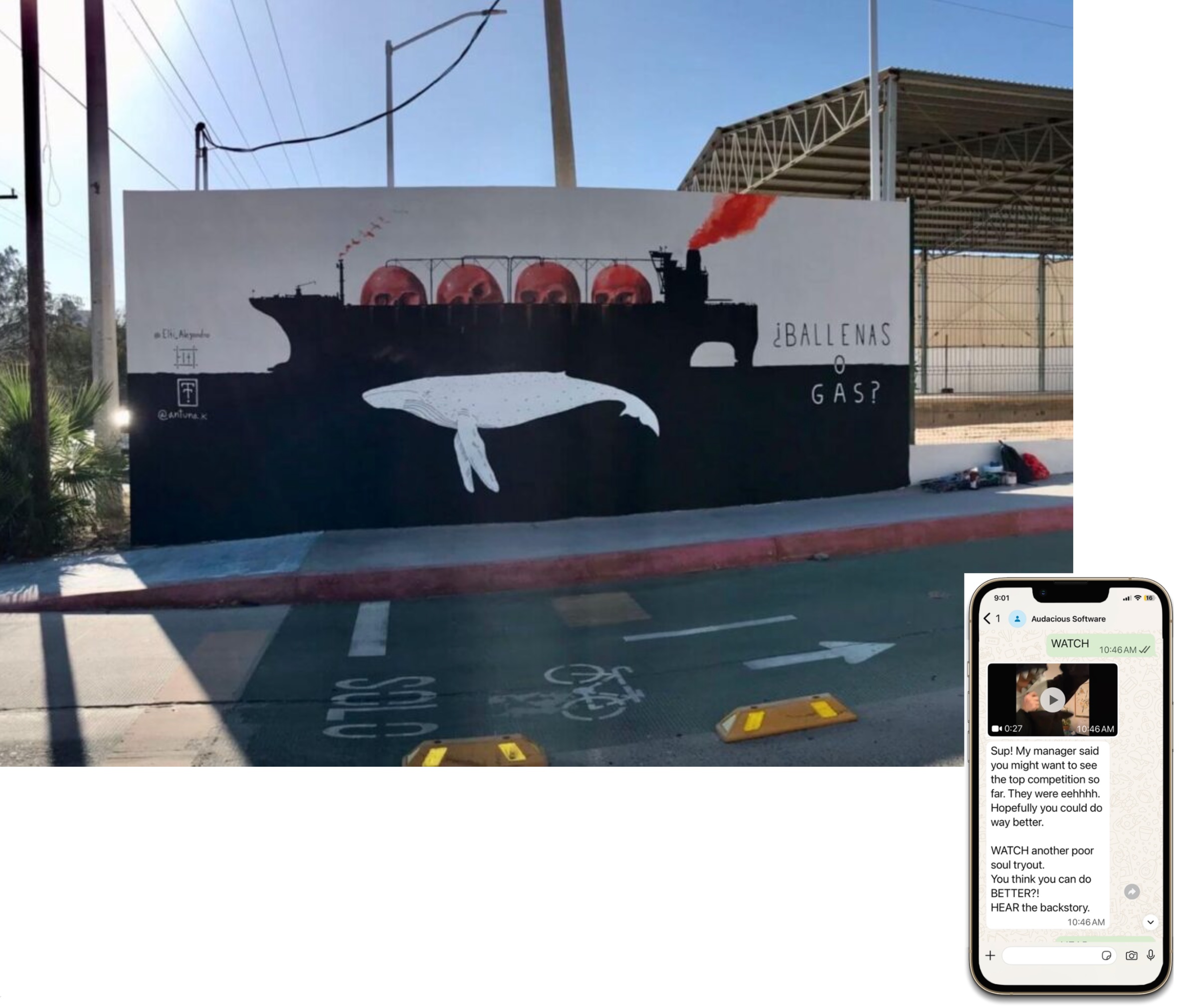
[This post reveals secrets from Mexico on making games across borders, and how “viable joy” is a critical strategy in three acts. The post is part of our “international” series on EBOW (Engaging Beyond Our Walls). Written by a researcher in our PhD program, Eric Schoenborn.] Imagine: You’re at a mural in Mexico. What if […]
Category: Designs
Design with a Glowing Sign: Balancing Attention in a Room
How might a glowing “nametag” launch a story game tied to a physical exhibit? Below we reveal a clever use of increasingly cheap LED signs ($10-30 USD) as a bridge to hidden stories and play. It is part of our research into respectful augmentation that (1) fits into an existing public space – especially libraries […]
Audio experience: “Insider Voice-Over” (a case study with the Black Feminist DC exhibition)
This month we launched an interactive audio project (“Community Voice: Katea Stitt“) with the National Women’s History Museum and the DC Public Library. It is part of a larger exhibit, “We Who Believe in Freedom: Black Feminist DC” that is on view in the central MLK Library through September 2024. Beyond this launch, more than […]
Hybrid Wayfinding Signs: No Neighborhood Left Behind
Wayfinding can be a powerful way to create a strong sense of place, which can drive business and cultural cohesion.
For installations: A DIY Box (aka, the “MiDI Bee” for Hive Mechanic)
This post is part of a series on physical installations, which are important for public space and can radically expand the possibilities for games made with Hive Mechanic and other interactive systems. Our goal is to publish blueprints that use cheap materials from the neighborhood hardware store, so that anyone can make their own. For […]
Simple Prototype Input Boxes featuring Makey Makey
In our search to democratize game design, our lab has been exploring the Makey Makey as a simple way to create your own “alternative controller.” The appeal in good part is that any old physical switch or button can be hooked up and function similarly to the arrow keys on a computer (plug-and-play!). Plenty of […]
New exhibit: Photo Mapping DC’s Alleys (at the District Architecture Center)
For this installation at the District Architecture Center, we invite residents of DC to “Show Us Your Alley” by cameraphone and help to reimagine public alleys. Our team’s contribution is a blend of playful visualization and what we call “conversational mapping” by text message — no apps required! The full show is ALLEY HOPPIN! Putting […]
Iterations on the Mount for the Classic Phone
The classic phone mount has become our most popular way to display our simple installation (including in libraries and the Humanities Truck), both for portability and the small footprint on-site. How did we get here? The initial box was long and unlabeled: The first prototype was more rectangular than future versions because. In part, this was accidental (it […]
Spanish Hotline and Dual Phones (“not an accident”)
In honor of Hispanic Heritage Month, we created a Spanish version of our hotline and installed a direct line at the Mt. Pleasant Neighborhood Library (on 9/17/2019). This library is a focus for Latino events and activities in the DC area, and was eager to refine their installation for the A Right to the City exhibition. […]
6+ Nodes for a Special Event (Adams Morgan Day, 2019)
Up until now, the most storytelling nodes we’ve launched for a live event was two for a cafe at night. But earlier this month we headed to a neighborhood music festival to test a multi-node approach. Our goal was to see how breadth might add up to more than the sum of the parts. We successfully featured four […]